DIY Setup Guide
How Can You Build a DIY Pickleball Court at Home Safely and Correctly?
A practical guide to space, measuring, surface prep, net height, drainage and fencing for a home pickleball court you build yourself.
DIY Setup Guide
A practical guide to space, measuring, surface prep, net height, drainage and fencing for a home pickleball court you build yourself.
Building a DIY pickleball court means choosing the right site, measuring an accurate 20-by-44-foot playing area, preparing a stable surface, applying a durable coating, painting regulation lines and installing a net at the correct height. Check your backyard pickleball court dimensions, drainage, surface condition, clearance, fencing and lighting needs before you start.
Painting lines on an existing driveway isn’t enough for a real DIY pickleball court. Measurements, surface prep, drainage, coating quality, line placement, net setup and surrounding clearance all shape the final playing experience. A simple project calls for an appropriate outdoor area, a concrete or asphalt surface, measuring tape and chalk line, court-marking tools, surface cleaner and crack-repair materials, a sports coating, line paint, and a net system, plus fencing and lighting if you want them.
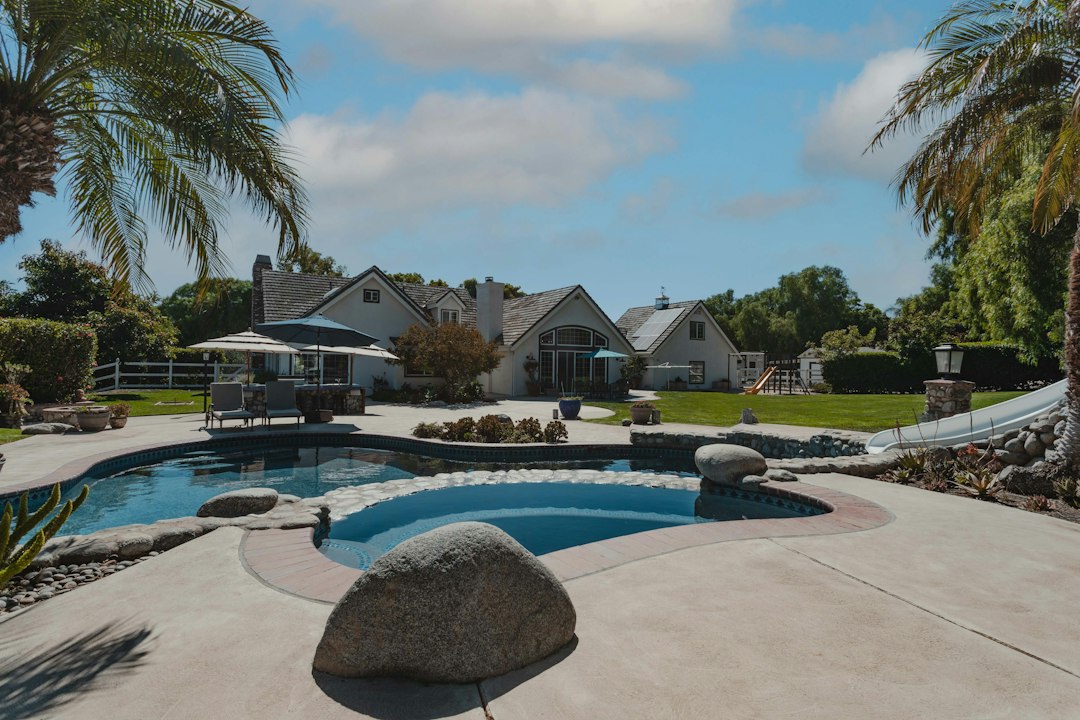
The regulation playing surface is 20 feet wide by 44 feet long, but building only that footprint leaves little room for players to move beyond the lines. Most home installations work better around 30 by 60 feet, and 34 by 64 feet gives even more comfortable clearance outside the sidelines and baselines.
Start by drawing a 44-by-20-foot rectangle, then mark the net’s center line and the court’s baselines, sidelines, kitchen lines, centerline and service areas. The kitchen (non-volley zone) sits 7 feet from the net on each side, so each kitchen area measures 20 by 7 feet. Mark this boundary with a chalk line and measuring tape before you paint anything, since a misplaced kitchen line affects regulation-style play.
Lines are typically 2 inches wide in white or another highly visible color, placed straight and consistently. The net should sit centered between the baselines at 36 inches high at the sidelines and 34 inches at the center. Portable nets work fine for casual use, while permanent posts set in concrete suit a dedicated court.
An existing driveway or concrete patio can work if it’s large enough, flat and in good condition. Check for major cracks, uneven areas, drainage problems, slope, oil stains and loose material first. Grass isn’t ideal since the surface needs to be hard and steady for consistent ball bounce, and pavers can create an uneven playing surface if joints have shifted. Whatever the base, clean it thoroughly, repair any damage, verify drainage and let repairs fully cure before coating.
Dink Pro Courts can help evaluate your backyard pickleball court dimensions, site conditions, drainage, surface prep, fencing, lighting and full court construction.
The right decision comes down to project complexity, not just cost.
When you already have a level slab with good drainage that fits comfortably and only needs coating and striping.
A new concrete slab, significant grading or drainage installation is usually best left to a professional crew.
Incorrect measurements, insufficient clearance, poor surface prep, ignored drainage, wrong net height and uneven striping.
Sites that want permanent fencing, continuous lighting or electrical work benefit from professional installation.
When a DIY project outgrows what's practical, Dink Pro Courts steps in throughout Maricopa County to handle site evaluation, base construction, surfacing, drainage, fencing and lighting as one coordinated project.
Yes. A DIY pickleball court can be created on a suitable concrete or asphalt surface if there is enough space, proper drainage, accurate measurements, and adequate surrounding clearance.
The regulation playing area is 20 feet by 44 feet. For a backyard installation, a total area of approximately 30 by 60 feet or more can provide better player clearance.
Standard backyard pickleball court dimensions use a 20-by-44-foot playing area. Approximately 30 by 60 feet or 34 by 64 feet of total space can provide additional room around the boundaries.
Yes, if the driveway is large enough, reasonably level, stable, and free from major cracks or drainage problems.
Concrete or asphalt with an acrylic sport-surface coating can provide a durable and consistent playing area.
The net should be 36 inches high at the sidelines and 34 inches high at the center.
Yes. Use accurate measurements, a chalk line, masking materials, and suitable line paint. Regulation lines are generally 2 inches wide.
Consider Dink Pro Courts if your project requires grading, new concrete, drainage work, resurfacing, fencing, lighting, permanent net installation, or a more durable professional court system.
Contact Dink Pro Courts today to discuss your space, court goals, surface options, and installation requirements.
Call or text (480) 493-0031, email build@dinkprocourts.com or submit the project form.