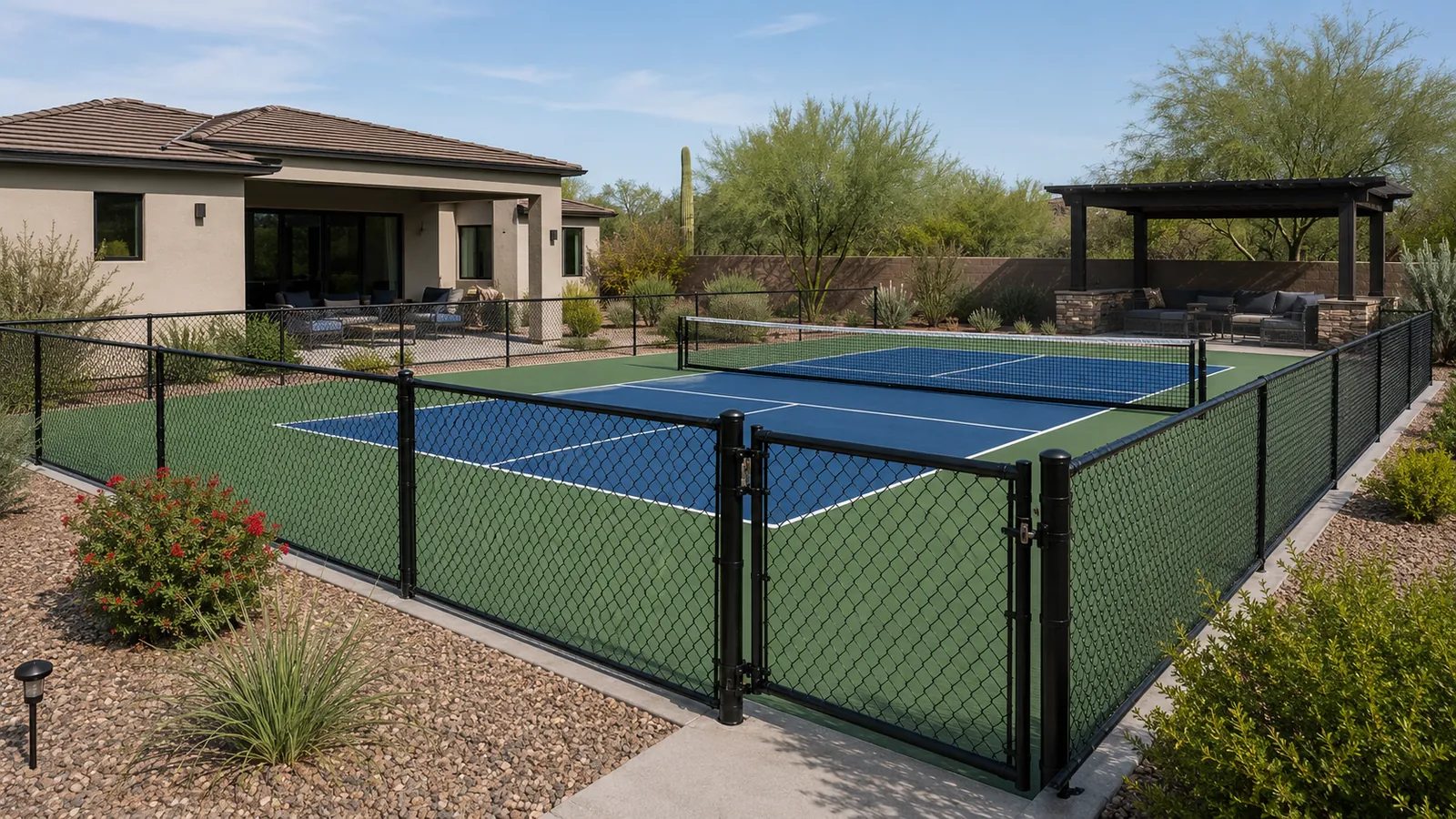
Pickleball court fencing is one of the most practical features homeowners can add to a backyard court. A court can look beautiful and still be frustrating if balls constantly roll into landscaping, pools, patios, windows, neighboring yards, or desert rock. Fencing helps define the court, improve safety, protect surrounding areas, and make play more enjoyable.
For Arizona homeowners, fencing is also a design decision. A backyard game court often sits near a pool, patio, outdoor kitchen, turf area, desert landscape, or luxury outdoor living space. The fence needs to support play without making the yard feel crowded or unattractive.
Dink Pro Courts helps homeowners plan pickleball courts, court fencing, acrylic sport surfaces, lighting, basketball hoop integration, and multi-sport backyard courts across Arizona. If you are just getting started, see our guide to pickleball court construction in Arizona for the full build process.
Short Answer: Does a Backyard Pickleball Court Need Fencing?
A backyard pickleball court does not always need fencing, but fencing is strongly recommended when the court is near landscaping, pools, patios, windows, property lines, neighboring homes, or outdoor living areas. Pickleball court fencing helps contain balls, reduce interruptions, protect nearby spaces, and create a safer playing environment.
Fencing is especially useful if:
- The court is near a pool
- The court is near windows or patio doors
- Landscaping surrounds the court
- Neighboring yards are close
- Kids or guests will use the court
- The court will also be used for basketball
- The court is part of a luxury backyard design
- You want a more finished court area
The right fencing plan depends on court layout, playing style, property size, and visual goals.
Why Fencing Matters for Pickleball Courts
Pickleball is played with a lightweight ball, but the ball can still travel off the court often during rallies, serves, returns, and missed shots. Without fencing, play may be interrupted repeatedly.
Fencing helps with:
- Ball containment
- Player safety
- Better game flow
- Property protection
- Court definition
- Reduced frustration
- Cleaner backyard design
For many homeowners, fencing is not just about sport. It is about protecting the rest of the backyard. A ball that repeatedly lands in desert rock, turf, pool water, planters, or patio furniture can make play less enjoyable.
Good fencing keeps the court usable and the backyard organized.
Fencing for Ball Containment
The most basic purpose of pickleball court fencing is ball containment. A well-placed fence keeps balls close to the playing area and reduces time spent chasing them.
Ball containment is especially important when the court is near:
- Pool areas
- Outdoor kitchens
- Patios
- Windows
- Sliding doors
- Neighboring yards
- Desert landscaping
- Turf areas
- Retaining walls
- Steep slopes
Some courts may need full perimeter fencing. Others may only need fencing behind baselines or along certain sides.
The fence layout should be based on how the court sits on the property.
Fencing and Court Safety
Fencing can improve safety, but only when it is placed correctly. If a fence is too close to the playing area, players may feel cramped or risk running into it during play.
A good fencing plan should allow enough space around the court lines for movement. The court should feel comfortable during serves, returns, kitchen play, and baseline rallies.
Safety planning should consider:
- Distance from court lines
- Gate location
- Fence height
- Post placement
- Surface transitions
- Padding needs in tight areas
- Nearby walls or structures
The goal is to contain balls without reducing the playability of the court.
Fence Height and Layout Options
There is no single fence layout that works for every backyard pickleball court. The right solution depends on the property and how the court will be used.
Common fencing approaches include:
Baseline Fencing — Fencing behind the baselines can be useful because many missed shots travel past the ends of the court. This can be a practical option when homeowners want some ball containment without a full enclosure.
Side Fencing — Side fencing may be useful when the court is close to landscaping, walls, neighboring yards, or patios.
Full Perimeter Fencing — Full perimeter fencing creates the most complete ball containment. It is often useful for active players, family courts, multi-game courts, and courts near sensitive backyard features.
Partial Decorative Fencing — Some luxury homes may use a more design-sensitive fencing approach that balances containment with appearance.
Dink Pro Courts can help homeowners decide which option fits the court and property.
Chain Link, Decorative, and Custom Fence Considerations
Chain link fencing is common around game courts because it is practical, visible, and effective for ball containment. However, residential and luxury properties may require more attention to appearance.
Fence choices may depend on:
- HOA rules
- Home design
- Landscape style
- Visibility from the home
- Neighbor views
- Budget
- Desired durability
- Court location
In some backyards, a simple dark-coated fence may work well. In others, fencing may need to coordinate with walls, gates, landscape screens, or existing outdoor design elements.
The fence should support the sport without harming the look of the backyard. Pairing the right fence with a durable playing surface matters too, so see our overview of acrylic court coating in Arizona for surface options that hold up in the heat.
Fencing for Basketball and Pickleball Combo Courts
Many backyard courts are designed for both pickleball and basketball. Fencing becomes even more important on these multi-game courts because basketballs can travel farther and with more force.
A basketball and pickleball combo court may need fencing that helps with:
- Rebounds behind the hoop
- Missed shots
- Ball containment along sidelines
- Protection for windows and pool areas
- Safe movement around the court
Fence placement should be coordinated with basketball hoop location, pickleball net setup, court lines, and lighting. Homeowners planning a dual-use layout should also review our basketball court construction Arizona guide for hoop placement and surface considerations.
If the court is planned poorly, fencing may interfere with play. If planned well, it makes the court more useful for both sports.
Fencing and Pickleball Court Lighting
Fencing and lighting should be planned together. Light poles, fixtures, gates, and fence posts can affect each other.
If lighting will be added, homeowners should consider:
- Pole placement
- Fence post location
- Electrical routing
- Gate access
- Fixture height
- Shadows
- Glare
- HOA review
A court should not be built first and then treated as if fencing and lighting are separate projects. The best results happen when the entire court environment is planned together, and our guide to backyard pickleball court lighting in Arizona walks through pole placement, fixture height, and glare control.
Fencing and Noise Considerations
Pickleball creates a distinctive sound. While fencing does not eliminate court noise, court placement and backyard design can help reduce neighbor concerns.
Homeowners can think about:
- Distance from neighboring homes
- Court orientation
- Landscape buffers
- Wall placement
- Sound-conscious design
- Hours of use
- HOA expectations
A good court plan considers not only how the court plays, but how it fits into the neighborhood.
Fencing for Luxury Backyard Courts
For luxury homes in Scottsdale, Paradise Valley, Fountain Hills, Cave Creek, Carefree, Arcadia, Biltmore, and North Scottsdale, fencing should be functional and attractive. Planning an estate court? See backyard court installation in Paradise Valley.
Luxury court fencing may need to coordinate with:
- Pool design
- Outdoor kitchens
- Desert landscaping
- Retaining walls
- View corridors
- Guest houses
- Patio spaces
- Landscape lighting
The fence should not look like an afterthought. It should feel like part of the finished outdoor recreation area.
Custom court colors, acrylic surfacing, fencing, and lighting should all work together.
Cost Factors for Pickleball Court Fencing
Pickleball court fencing cost depends on the layout and project scope.
Important cost factors include:
- Fence height
- Fence length
- Material
- Coating or finish
- Gate placement
- Number of gates
- Existing walls
- Site access
- Court size
- Property slope
- HOA design requirements
- Whether lighting is included
Partial fencing will usually cost less than full perimeter fencing. Decorative or custom fencing may cost more than basic chain link.
The best approach is to decide what the fence needs to do before choosing the material and layout. For a full cost breakdown of backyard court projects, see our pickleball court construction cost Arizona guide.
Common Fencing Mistakes to Avoid
Avoid these mistakes:
- Placing the fence too close — a fence that is too close to the playing area can make the court feel cramped and less safe
- Forgetting gate access — gates should be placed where players, equipment, and maintenance access make sense
- Ignoring the rest of the backyard — the fence should protect nearby features and work with the landscape, not fight against it
- Choosing appearance without function — a fence may look good but fail to contain balls properly; function matters
- Adding fencing after everything else — fencing should be part of the original court plan, especially when lighting, landscaping, or multi-sport use is involved
Why Choose Dink Pro Courts?
Dink Pro Courts helps Arizona homeowners build backyard pickleball courts, basketball courts, tennis courts, and multi-game courts with practical design features like fencing and lighting.
Dink Pro Courts can help with:
- Pickleball court fencing
- Backyard court layout
- Pickleball court construction
- Acrylic court coating
- Basketball and pickleball combo courts
- Court lighting planning
- Pickleball nets
- Basketball hoops
- Custom game court design
The right court fencing plan should improve play, protect the property, and make the backyard feel more complete.
Final Thoughts
Pickleball court fencing is not just an add-on. It is part of the playing experience. The right fence keeps balls contained, protects the backyard, improves safety, and helps the court feel finished.
For Arizona homeowners, fencing should also be planned with lighting, surface colors, landscape, HOA rules, and multi-sport use in mind.
If you are planning pickleball court installation in Phoenix, Scottsdale, Paradise Valley, Peoria, Glendale, Chandler, Queen Creek, Fountain Hills, Mesa, Gilbert, Surprise, or nearby Arizona areas, Dink Pro Courts can help design a court and fencing plan that fits your property.
Contact Dink Pro Courts to start planning pickleball court fencing in Arizona.
Landscaping Around a Pickleball Court Fence
Fence landscaping softens a court and adds privacy, but plants placed too close cause problems on the playing surface. A few rules for Arizona yards:
- Keep shrubs and trees back far enough that roots don’t reach the court slab and leaves don’t pile up on the surface.
- Use drip irrigation near the court and aim sprinklers away from it. Water on an acrylic surface leaves stains and shortens its life.
- Choose low-water desert plants that don’t shed much. Avoid trees that drop a lot of pods, berries or sap near the fence.
- Leave a gravel or decomposed granite strip along the fence line for drainage and maintenance access.
- Plant tall screening shrubs or vines on the neighbor side to soften the fence and reduce sight lines.
Dink Pro Courts builds the court and fence. Licensed landscape partners handle the landscape work. See landscape and backyard design-build.
FAQs About Pickleball Court Fencing
Fencing is not always required, but it is recommended when the court is near landscaping, pools, patios, windows, or neighboring property lines.
It helps contain balls, protect surrounding areas, define the court, reduce interruptions, and improve safety.
Yes. Some courts only need fencing behind baselines or along certain sides. The right layout depends on the property.
Yes. Fencing should be considered early so it works with court size, lighting, gates, drainage, and landscape design.
Yes. Combo courts often benefit from fencing because basketballs and pickleballs can both leave the playing area.
Possibly. Many HOAs review fence height, location, color, design, and visibility.
The best fence depends on budget, appearance, ball containment needs, and HOA rules. Chain link is common, but custom options may work better for some homes.
Yes. Dink Pro Courts helps homeowners plan fencing as part of complete backyard game court projects.
Low-water desert shrubs and vines that don’t shed much, kept back from the slab and watered by drip irrigation rather than spray.
Far enough that roots stay out from under the slab and leaves stay off the court. Leave a gravel strip along the fence for drainage and access.
Yes. Light poles often sit along the fence line, so fence height, gates and pole locations belong in the same plan. If you are not ready for lights yet, we can lay conduit while the court is built, so LED lights can go in later without trenching through the new surface.
There is no single standard height. Dink Pro Courts builds anything from a 4 ft low fence up to an 8 ft high fence, based on what you want, how much ball containment you need and what your HOA allows.
