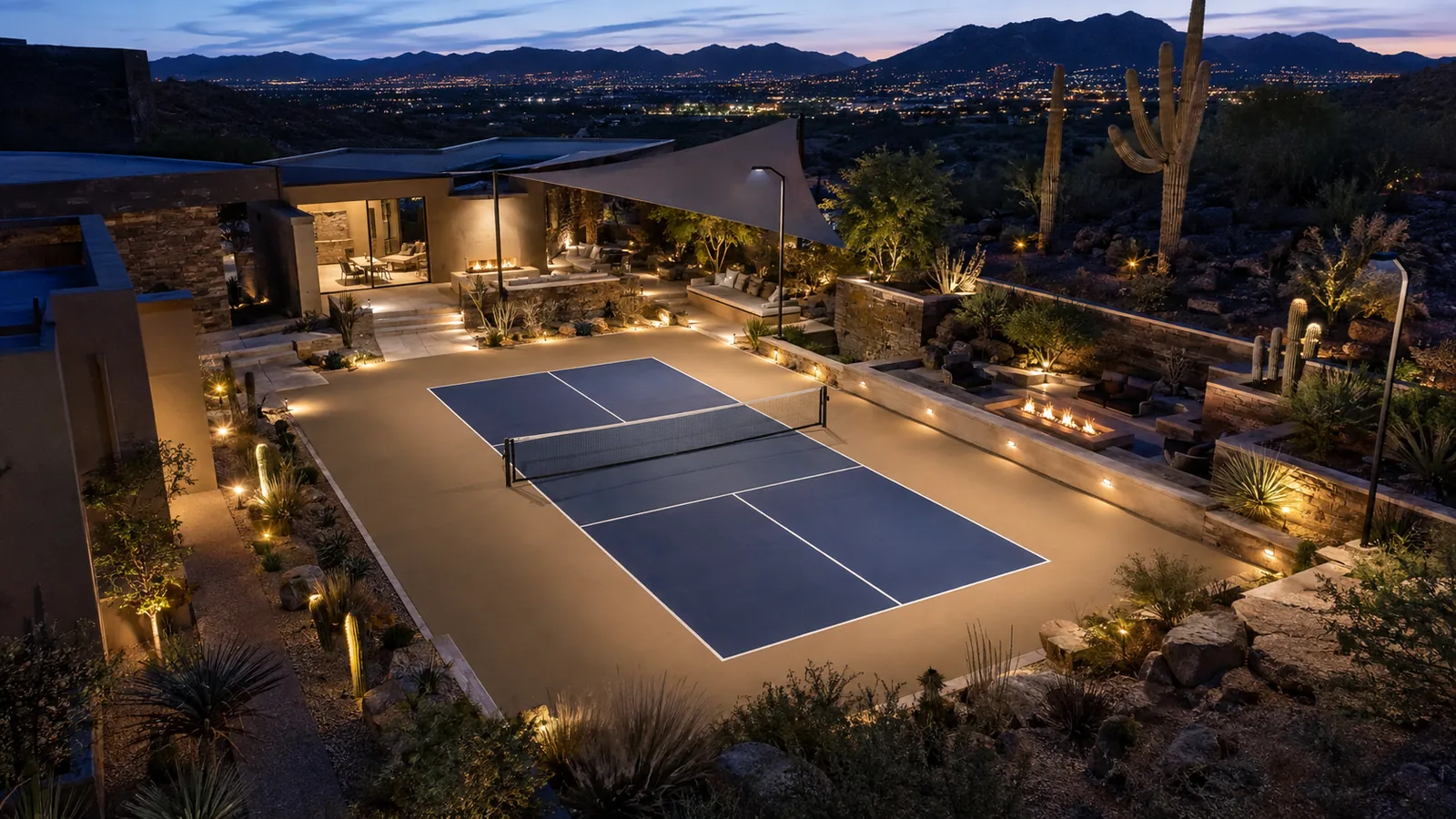
Backyard pickleball court lighting is one of the most important upgrades Arizona homeowners can consider when building a private court. In a hot climate, evening play is often more comfortable than midday play, and good lighting can make a backyard court more useful for family games, practice sessions, guests, and weekend gatherings.
But lighting should not be treated as an afterthought. A pickleball court is a fast-moving playing surface, and poor lighting can create glare, shadows, blind spots, neighbor concerns, and HOA issues. A good lighting plan should be discussed during the design stage, before the court surface, fencing, and landscape work are finalized.
Dink Pro Courts helps Arizona homeowners plan backyard pickleball courts, game courts, fencing, lighting, acrylic surfacing, and multi-sport layouts that fit the property and the way the court will be used.
Short Answer: Do Backyard Pickleball Courts Need Lighting?
Backyard pickleball courts do not always need lighting, but lighting is a smart option for Arizona homeowners who want to play in the evening, avoid peak daytime heat, host guests, or make the court more useful year-round. Pickleball court lighting should be planned early so fixture placement, electrical access, glare, shadows, neighbors, and HOA requirements can be handled correctly.
Lighting may be worth adding if you want:
- Evening pickleball games
- Better court visibility
- Safer movement after sunset
- More use during warmer months
- Family play after work or school
- Guest entertainment
- A more finished backyard court design
- Future flexibility for regular play
Even if lighting is not installed immediately, planning for it during construction can make future upgrades easier.
Why Lighting Matters for Arizona Backyard Courts
Arizona homeowners often deal with intense sun and high daytime temperatures. For many families, the most comfortable time to play pickleball is early morning or evening. Without lighting, the usable hours of a backyard court may be limited.
Lighting can make a court more useful because it extends play into the evening. This is especially valuable for homeowners who work during the day, families with school schedules, and players who prefer cooler temperatures.
Good lighting also improves the overall backyard experience. A well-lit court can become part of an outdoor entertainment area with a pool, patio, outdoor kitchen, seating, and landscape lighting.
However, court lighting must be designed carefully. The goal is visibility on the court, not bright light spilling into neighboring homes or creating glare for players.
Plan Lighting Before the Court Is Built
The best time to discuss lighting is during the initial court planning phase. If you are still mapping out your project, see our guide to pickleball court construction in Arizona for the full build process.
Early planning helps with:
- Electrical routing
- Conduit placement
- Pole or fixture location
- Fence coordination
- Landscape coordination
- HOA review
- Glare control
- Future upgrade planning
If lighting is added after the court is finished, the project may require more disruption. Contractors may need to cut into landscape areas, reopen hardscape, add electrical routes, or work around finished fencing and surface coatings.
Homeowners do not always need to install lights right away, but they should ask whether the court can be prepared for future lighting.
Key Factors in Pickleball Court Lighting Design
A good lighting plan considers more than brightness. The fixtures must be placed so the court is visible, balanced, and comfortable for play.
Important lighting factors include:
- Fixture height
- Fixture angle
- Number of lights
- Pole placement
- Electrical access
- Shadows
- Glare
- Neighbor impact
- Court orientation
- Fencing location
- Landscape lighting nearby
- HOA or city requirements
Pickleball involves quick reactions, short volleys, and fast ball movement. Players need to clearly see the ball, court lines, net, and nearby boundaries.
Lighting that is too low, uneven, or poorly aimed can make the court harder to use.
Avoiding Glare and Shadows
Glare is one of the biggest problems with poor court lighting. If fixtures shine directly into players’ eyes, the court may technically be lit but still uncomfortable to use.
Shadows can also create problems. If light is uneven, players may lose sight of the ball as it moves from bright areas into dark areas.
A good lighting layout should aim for balanced visibility across the playing surface. It should also consider how players move during serves, returns, kitchen play, and baseline rallies.
For backyard courts, lighting should also respect neighboring properties. Proper fixture direction and placement, coordinated with your pickleball court fencing, can reduce unnecessary light spill.
Lighting and HOA Considerations
Many Arizona communities have HOA rules or architectural review requirements. Lighting can be one of the most sensitive parts of a backyard game court project.
HOAs may review:
- Fixture height
- Light brightness
- Light direction
- Pole location
- Hours of use
- Visibility from neighboring lots
- Design appearance
- Electrical work
- Neighbor impact
Homeowners should review HOA rules before committing to a lighting plan. In some communities, approval may be required before installation.
Dink Pro Courts can help homeowners think through questions to raise during HOA review, but homeowners should confirm final requirements with their HOA, city, or county.
Lighting for Pickleball and Basketball Combo Courts
Many backyard courts are built for more than one sport. A basketball and pickleball combo court may need lighting that works for both activities, often paired with a durable acrylic court coating across the full playing surface.
Basketball court construction lighting needs to cover the hoop, key, shooting areas, and rebounding zones. Pickleball lighting needs to cover the full court, kitchen area, net, baselines, and sidelines.
If the court serves both sports, lighting should be planned around the complete layout, not just one game.
A combo court may include:
- Pickleball lines
- Basketball hoop
- Acrylic court surface
- Fencing
- Court lighting
- Portable or permanent pickleball net
- Custom colors
Planning the lighting together with the surface and equipment layout helps the court feel complete.
Should Lights Be Mounted on Poles or Structures?
Court lights may be mounted on dedicated poles or coordinated with nearby structures, depending on the property and design. The right approach depends on visibility needs, electrical access, court layout, fence placement, and property design.
Dedicated light poles can provide better placement control, but they may require HOA review and careful visual planning. Structure-mounted lighting may work in some settings but can create angle and shadow limitations.
The goal is not simply to add light. The goal is to create a court that is comfortable and safe to play on after sunset.
Lighting and Court Orientation
Court orientation affects both daytime and nighttime play. During the day, sun direction matters. At night, light direction and fixture placement matter.
When a court is planned correctly, lighting can work with the court orientation rather than against it. If lighting is ignored until the end, homeowners may discover that ideal fixture locations conflict with fences, landscaping, walls, or neighboring property lines.
That is why lighting should be part of the first design conversation.
Cost Factors for Backyard Court Lighting
The cost of backyard pickleball court lighting depends on the project scope.
Important cost factors include:
- Number of fixtures
- Fixture quality
- Pole height and placement
- Electrical distance
- Conduit needs
- Controls and switches
- Trenching
- HOA requirements
- Existing landscape conditions
- Whether lighting is installed during or after court construction
Lighting added during the original court build may be easier to coordinate than lighting added later. Planning early can help homeowners avoid unnecessary rework – for a broader breakdown of project pricing, see our guide to pickleball court construction cost in Arizona.
Common Lighting Mistakes to Avoid
Avoid these common mistakes when planning backyard pickleball court lighting:
- Adding lights too late – lighting should be discussed before the court is built so electrical routes and fixture locations can be planned properly
- Using general backyard lights only – patio or landscape lights are not the same as court lighting; a game court needs proper coverage across the playing surface
- Ignoring glare – bright lights are not automatically good lights; fixtures must be aimed and positioned to reduce glare
- Forgetting about neighbors – backyard court lighting should be designed with surrounding homes in mind
- Not checking HOA rules – lighting may require approval depending on the community
Why Choose Dink Pro Courts?
Dink Pro Courts helps homeowners plan pickleball courts, basketball courts, tennis courts, and multi-game courts across Arizona.
Dink Pro Courts can help with:
- Backyard pickleball court planning
- Court lighting planning
- Court fencing coordination
- Pickleball court construction
- Acrylic court coating
- Basketball and pickleball combo courts
- Pickleball nets
- Basketball hoops
- Custom game court design
The best court is planned as a complete space. Lighting, fencing, surface, equipment, and landscape fit should all work together.
Final Thoughts
Backyard pickleball court lighting can make a private court more useful, comfortable, and enjoyable. For Arizona homeowners, evening play is a major advantage, especially during warmer months.
But lighting needs to be planned properly. Fixture placement, glare, shadows, electrical access, HOA rules, and neighbor impact all matter.
If you are building a backyard pickleball court in Phoenix, Scottsdale, Paradise Valley, Peoria, Glendale, Chandler, Queen Creek, Fountain Hills, Mesa, Gilbert, Surprise, or nearby Arizona areas, Dink Pro Courts can help you plan a court that works during the day and after sunset.
Contact Dink Pro Courts to start planning backyard pickleball court lighting in Arizona.
FAQs About Backyard Pickleball Court Lighting in Arizona
You do not always need lights, but lighting is helpful if you want evening play, better visibility, and more usable court hours.
Lighting should be planned during the initial court design stage, even if the lights will be installed later.
Yes, but it may be more complicated and expensive than planning for it during construction.
Poorly placed lights can create glare. A good lighting plan should focus on balanced visibility and player comfort.
Possibly. Many communities review lighting height, brightness, direction, and neighbor impact.
Yes, if the lighting is planned around the full multi-game court layout.
Yes. Lighting adds cost through fixtures, poles, electrical work, controls, and installation planning.
Yes. Dink Pro Courts plans and installs court lighting as part of the build, using Dominator lighting products. The layout depends on your court size and the sports you play, so there is no one fixed pole count or height. We design it for your court, neighbors and HOA rules.
