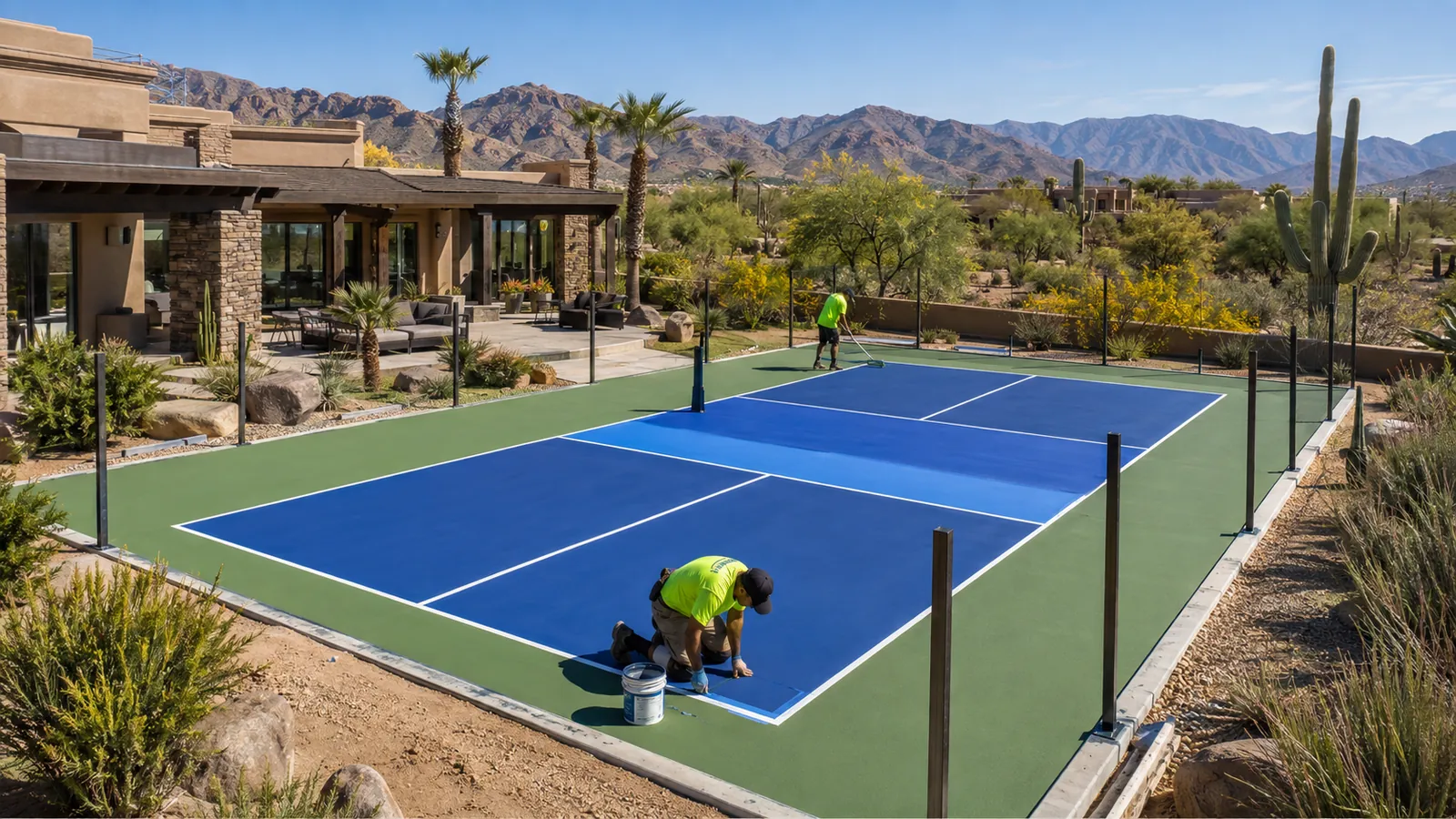
Planning a backyard pickleball court in Phoenix or anywhere in Arizona? This guide walks through pickleball court installation from layout to net: location, dimensions, grading, the concrete base, the acrylic surface, striping, fencing, lighting and permits. A private court is one of the most valuable backyard upgrades for Arizona homeowners who want more recreation, better outdoor living and a place to play at home. Across Phoenix, Scottsdale, Paradise Valley, Cave Creek, Carefree, Fountain Hills, Gilbert, Chandler, Mesa, Queen Creek, Glendale, Peoria, Surprise, and other Maricopa County communities, more homeowners are turning unused outdoor space into custom pickleball courts.
A private court gives families the freedom to play without waiting for public courts, driving to a facility, or working around busy schedules. It also adds a strong lifestyle feature to luxury homes, custom properties, and family backyards.
But building a pickleball court is not just about painting lines on concrete. A long-lasting court needs the right location, proper dimensions, site preparation, drainage, base construction, surface coating, fencing, lighting, and equipment. If these details are planned well, the court can become one of the most-used areas of the property.
Dink Pro Courts helps Arizona homeowners plan and build custom pickleball courts designed for local outdoor conditions, family use, and long-term performance.
What Is Included in Pickleball Court Construction?
Pickleball court construction includes planning the court layout, preparing the site, grading the area, building the court base, applying the sport surface, striping the game lines, installing the net system, and adding features such as fencing, lighting, drainage, shade, and basketball hoops when needed.
A complete backyard pickleball court may include:
- Site evaluation
- Court layout planning
- Grading and base preparation
- Concrete court base
- Drainage planning
- Acrylic sport surface
- Pickleball game lines
- Net installation
- Fencing
- Lighting
- Optional basketball hoop
- Optional multi-sport striping
- Final finishing and cleanup
The best pickleball courts are planned around the property, not forced into the yard without considering space, drainage, slope, sun direction, and daily use. See how we approach pickleball court design in Arizona before construction starts.
Why Pickleball Court Construction Is Growing in Arizona
Arizona is one of the best places for outdoor recreation. The weather, lifestyle, and backyard-focused homes make pickleball a natural fit. Many homeowners already invest in pools, patios, outdoor kitchens, putting greens, turf areas, and entertainment spaces. A backyard pickleball court fits into that same outdoor living mindset.
For families, it creates a simple way to stay active at home. For retired homeowners, it offers a convenient sport that supports movement and social play. For luxury properties, it adds a premium recreation feature that feels modern and useful.
Pickleball is also easier to fit into many backyards than tennis. A full tennis court requires much more space, while a pickleball court can often be planned within a smaller footprint. This makes it a strong option for homes in Phoenix, Scottsdale, Paradise Valley, Cave Creek, Gilbert, Chandler, Mesa, Queen Creek, and surrounding areas. If you already have an old tennis court, converting it to pickleball can be a faster route than building new.
Step 1: Choosing the Right Location for the Court
The first step in pickleball court construction is choosing where the court should go. This decision affects the entire project.
A good court location should consider:
- Available space
- Property slope
- Drainage flow
- Sun direction
- Distance from the home
- Distance from neighbors
- Access for construction equipment
- Nearby pools, patios, walls, and landscaping
- Fencing and lighting options
- HOA or permit requirements
Many homeowners first think about where the court will fit, but the better question is where the court will perform best.
For example, a flat area may look perfect at first, but it may collect water after rain. A space near a pool may look convenient, but it may create safety or ball-containment issues. A corner of the yard may have enough room, but it may be too close to neighboring homes for regular play.
A professional site review helps avoid these problems before construction begins.
Step 2: Understanding Pickleball Court Dimensions
A standard pickleball court has a playing area of 20 feet wide by 44 feet long. However, the painted lines are not the full amount of space needed for comfortable play.
Players need extra room outside the lines to move, serve, return shots, and avoid fences or walls. For many backyard pickleball court projects, homeowners consider an overall playing area of around 30 feet by 60 feet or larger when space allows.
A larger area gives players more room behind the baseline and along the sides. This creates a better playing experience, especially for adults, experienced players, and families who plan to use the court often.
When planning dimensions, homeowners should also allow space for:
- Net posts
- Fencing
- Gates
- Walkways
- Seating
- Lighting poles
- Drainage
- Landscape borders
- Equipment storage
Trying to force a full court into a space that is too small can make the court uncomfortable. A smaller practice court may still be useful, but it should be planned honestly as a compact recreational court, not a full playing court.
Step 3: Site Preparation and Grading
Site preparation is one of the most important parts of pickleball court construction. A good surface depends on what happens underneath it.
Arizona properties can vary widely. Some backyards are flat and open. Others have slope, desert landscaping, hardscape, drainage channels, retaining walls, or limited access.
Before the court base is built, the site may need:
- Clearing
- Excavation
- Grading
- Soil preparation
- Compaction
- Drainage planning
- Base material installation
- Edge preparation
If the site has a slope, additional grading or retaining solutions may be needed. If water naturally moves across the area, drainage must be planned before the court is built.
A court surface should not be treated like a patio slab. It needs to support consistent play, proper water movement, and long-term durability. Poor site preparation can lead to standing water, cracking, uneven play, and premature surface wear. If an existing court already shows these problems, start with pickleball court repair.
Step 4: Concrete or Asphalt Base
Most outdoor pickleball courts are built over a properly prepared concrete or asphalt base. The right option depends on the property, project goals, budget, site conditions, and contractor recommendations.
Concrete is often used for residential pickleball courts because it can provide a strong and stable base when installed correctly. Asphalt can also be used in certain court projects, but Dink Pro Courts builds concrete courts only.
The base is critical because the final acrylic surface will only perform as well as the structure below it. If the base is poorly prepared, the finished court may develop issues later.
Important base considerations include:
- Proper thickness
- Soil conditions
- Compaction
- Drainage
- Slope for water movement
- Surface preparation
- Curing time
- Crack control
- Long-term stability
This is why pickleball court construction should be handled by experienced court builders, not just general concrete contractors. A court must be built for sport performance, not only appearance.
Step 5: Acrylic Pickleball Court Surface
After the base is prepared, the court surface system is applied. For many outdoor pickleball courts, an acrylic sport coating is used to create the finished playing surface.
Acrylic court coating helps provide:
- A consistent playing feel
- Proper ball response
- Surface texture
- Court color
- Game line visibility
- A clean finished appearance
Arizona homeowners can often choose custom court colors to match the property, landscape, or backyard design. Popular designs may use bold sport colors, neutral luxury tones, or combinations that coordinate with pool decking and patio materials.
The surface should be selected for more than looks. It should support outdoor play, traction, movement, and long-term maintenance.
Some homeowners may also consider cushioned surface systems for added comfort. This can be helpful for players who want a softer feel underfoot, especially if the court will be used frequently.
Step 6: Pickleball Court Striping
Court striping may seem simple, but clean line work is important. The lines need to be accurate, visible, and properly placed.
A standard pickleball court includes:
- Baselines
- Sidelines
- Non-volley zone lines
- Centerline
- Service areas
If the court will also be used for basketball or other sports, the striping plan becomes more important. A multi-game court should be easy to understand. Too many overlapping lines can make the court look cluttered and confusing.
For basketball and pickleball combo courts, the color design should create clear separation between game markings. The goal is to make the court useful for multiple sports without making it look messy.
Step 7: Pickleball Net Installation
A pickleball court needs a proper net system. Homeowners can choose between permanent and portable net options depending on the court layout.
A permanent net is ideal for a dedicated backyard pickleball court. It gives the court a clean and professional feel and is always ready for play.
A portable net may be better for a multi-game court where the space is also used for basketball, family activities, or other games.
The right net choice depends on:
- Whether pickleball is the primary sport
- Whether the court is multi-purpose
- How often the court will be used
- Who will use the court
- Whether flexibility is important
Dink Pro Courts can also help homeowners with pickleball nets, paddles, basketball hoops, and other court accessories.
Step 8: Fencing for Backyard Pickleball Courts
Fencing is not always required, but it is often very helpful. A backyard pickleball court without fencing may lead to balls rolling into landscaping, pools, patios, or neighboring areas.
Fencing can help:
- Keep balls inside the court area
- Protect landscaping
- Improve the playing experience
- Define the court space
- Reduce interruptions
- Add a finished look
The fence does not always need to surround the entire court in the same way. Some properties may need higher fencing behind the baselines and lower fencing on the sides. Others may use existing walls or landscape barriers as part of the design.
For luxury backyards, fencing should be planned carefully so the court does not feel boxed in or visually heavy.
Step 9: Lighting for Evening Play
Court lighting can make a backyard pickleball court much more useful, especially in Arizona. Many homeowners prefer to play in the evening when temperatures are more comfortable.
Lighting should be planned early, not added as an afterthought.
A good court lighting plan considers:
- Fixture placement
- Pole locations
- Shadows
- Glare
- Neighboring homes
- Electrical access
- Court orientation
- Local rules or HOA requirements
Poor lighting can create dark spots, harsh glare, or uncomfortable play. Proper lighting helps the court feel safer and more enjoyable after sunset.
If a homeowner is not ready to add lighting immediately, it may still be smart to plan for future lighting during construction.
Step 10: Court Orientation and Sun Direction
Court orientation matters in Arizona because sun exposure can affect play. Where the property allows, a north-south court orientation is commonly preferred because it can reduce the chance of players looking directly into low sun during morning or evening play.
However, not every backyard allows perfect orientation. The final layout may need to balance:
- Sun direction
- Property shape
- Home location
- Pool placement
- Views
- Slope
- Drainage
- Neighboring properties
- Available space
A good court builder will help find the best practical layout for the property.
Pickleball Court Construction Cost Factors
The cost of pickleball court construction can vary significantly. No two backyards are exactly the same, and no single price applies to every project. For a full breakdown, see what a backyard pickleball court costs in Arizona.
Important cost factors include:
- Court size
- Site access
- Grading needs
- Soil conditions
- Drainage work
- Concrete base
- Surface system
- Court colors
- Fencing
- Lighting
- Net system
- Basketball hoop or multi-sport features
- Landscaping
- Permits or HOA requirements
- Custom design details
A basic court on a flat, accessible site will cost less than a luxury backyard court with grading, retaining work, premium surfacing, fencing, lighting, and basketball integration.
For homeowners comparing prices, the goal should not be to find the cheapest court. The goal should be to understand what is included, what may be missing, and how the court will perform over time.
A low estimate may leave out important items such as drainage, fencing, surface quality, or proper base preparation.
Can a Pickleball Court Include Basketball?
Yes. Many Arizona homeowners choose a pickleball and basketball combo court because it gives the backyard more flexibility.
A combo court may include:
- Pickleball lines
- Basketball hoop
- Basketball key
- Custom acrylic surface
- Portable or permanent pickleball net
- Multi-sport layout
- Lighting
- Fencing
This is especially popular for families. Parents may want pickleball, kids may want basketball, and guests may enjoy both. A well-designed combo court can support different activities without requiring separate court areas.
Dink Pro Courts also sells basketball hoops, pickleball nets, and pickleball paddles, making it easier to complete the full backyard court setup.
Do You Need a Permit for Pickleball Court Construction?
Permit requirements depend on the property location and project scope. Arizona homes may fall under different city, town, county, or HOA requirements.
A backyard pickleball court may require additional review if the project includes:
- Grading
- Drainage changes
- Retaining walls
- Fencing
- Lighting
- Electrical work
- Structural features
- Work near setbacks or easements
Homeowners in Phoenix, Scottsdale, Paradise Valley, Cave Creek, Gilbert, Chandler, Mesa, Queen Creek, Glendale, Peoria, and other Maricopa County communities should confirm local requirements before construction begins.
HOA approval may also be needed in many communities. HOAs may review court location, colors, fencing, lighting, noise, and visibility from neighboring properties.
Pickleball Court Construction for Luxury Homes
For luxury homes in Scottsdale, Paradise Valley, North Scottsdale, Arcadia, Biltmore, Carefree, Cave Creek, and Fountain Hills, pickleball court construction should be treated as part of the full outdoor living design.
A high-end court may include:
- Custom court colors
- Premium acrylic surfacing
- Cushioned surface options
- Landscape integration
- Court lighting
- Ball containment fencing
- Seating areas
- Basketball hoop integration
- Connection to pool and patio areas
The court should not feel like a separate slab placed in the yard. It should feel connected to the home, the landscape, and the way the family uses the property.
Dink Pro Courts understands that luxury court construction is about more than play. It is about creating a polished, functional, long-term backyard feature.
Pickleball Court Construction and Installation Across Arizona and Maricopa County
Dink Pro Courts serves homeowners across Arizona and Maricopa County, including:
- Phoenix
- Scottsdale
- Paradise Valley
- Cave Creek
- Carefree
- Fountain Hills
- Gilbert
- Chandler
- Mesa
- Queen Creek
- Glendale
- Peoria
- Surprise
- North Scottsdale
- Arcadia
- Biltmore
- Tempe
For local details, see pickleball court installation in Phoenix, AZ, pickleball court contractor in Chandler and backyard court installation in Paradise Valley.
Each area has different property styles and planning needs. A backyard court in Paradise Valley may involve luxury landscape integration. A Cave Creek property may require slope and drainage planning. A Phoenix backyard may need a compact but functional layout. A Gilbert or Chandler home may need a family-friendly combo court.
The best pickleball court construction plan starts with the property.
Why Choose Dink Pro Courts for Pickleball Court Construction?
Dink Pro Courts helps homeowners design and build custom pickleball courts, game courts, and backyard recreation spaces in Arizona.
Homeowners choose Dink Pro Courts for:
- Custom pickleball court construction
- Backyard court planning
- Multi-game court layouts
- Basketball and pickleball combo courts
- Acrylic court coating
- Court resurfacing
- Fencing and lighting planning
- Basketball hoops
- Pickleball nets
- Pickleball paddles
- Local Arizona court expertise
The team understands how to plan courts for Arizona homes, outdoor conditions, and long-term use. From the first layout conversation to the finished playing surface, the focus is on building a court that fits the property and the people who will use it.
Final Thoughts: Build a Pickleball Court That Fits Your Home
Pickleball court construction is a major backyard investment. When planned properly, it can become a daily recreation space, a family gathering area, and a valuable lifestyle upgrade.
The best courts are not copied from a template. They are designed around the home, the property, the players, and the way the space will be used.
If you are planning a backyard pickleball court in Phoenix, Scottsdale, Paradise Valley, Cave Creek, Gilbert, Chandler, Mesa, Queen Creek, Glendale, Peoria, Surprise, or anywhere in Maricopa County, Dink Pro Courts can help you plan and build a court that works for your property.
Whether you want a dedicated pickleball court, a basketball and pickleball combo court, a luxury backyard game court, or a full outdoor recreation space, the right construction plan makes all the difference.
Contact Dink Pro Courts to start planning your custom pickleball court construction project in Arizona.
FAQs About Pickleball Court Construction
How much space do I need for a backyard pickleball court?
A standard pickleball court has playing lines that measure 20 feet by 44 feet. However, homeowners should plan for extra space around the court so players can move comfortably and safely.
How long does pickleball court construction take?
The timeline depends on the site, grading needs, base construction, curing time, surface work, fencing, lighting, and weather. A simple project may move faster than a complex luxury backyard court.
What is the best surface for a pickleball court in Arizona?
Many outdoor pickleball courts use an acrylic sport surface over a properly prepared concrete or asphalt base. The best option depends on the court design, playing goals, and long-term maintenance needs. Dink Pro Courts builds concrete courts only.
Can I build a pickleball court in my backyard?
Yes, many Arizona homeowners can build a backyard pickleball court if the property has enough usable space and the project meets local, HOA, and site requirements.
Do I need a permit for pickleball court construction?
Permit requirements depend on your city, town, county, HOA, and project scope. Grading, fencing, lighting, drainage, electrical work, and retaining features may affect approval needs.
Can a pickleball court also include basketball?
Yes. A basketball and pickleball combo court is a popular option for homeowners who want one backyard court for multiple activities.
What affects pickleball court construction cost?
Cost depends on court size, site preparation, grading, drainage, surface system, fencing, lighting, net system, basketball equipment, and custom design features.
Can Dink Pro Courts build pickleball courts in Phoenix and Scottsdale?
Yes. Dink Pro Courts serves Phoenix, Scottsdale, Paradise Valley, Cave Creek, Carefree, Fountain Hills, Gilbert, Chandler, Mesa, Queen Creek, Glendale, Peoria, Surprise, and surrounding Arizona communities. For local details, see our Phoenix pickleball court builder and Scottsdale pickleball court construction pages.
Should I add lighting to my backyard pickleball court?
Lighting is a good option if you want to play in the evening. It should be planned early so fixture placement, electrical access, shadows, and glare are handled correctly.
Can I choose custom colors for my pickleball court?
Yes. Acrylic court surfaces can often be customized with different color combinations to match your backyard, home, or design preference.
Who installs backyard pickleball courts in Phoenix?
Dink Pro Courts plans and installs backyard pickleball courts across Phoenix, including Arcadia, North Central, Ahwatukee and North Phoenix, and throughout Maricopa County. Our team brings 20+ Years Experience.
Do you build pickleball courts on concrete or asphalt?
Concrete. Dink Pro Courts builds concrete courts only, usually post-tensioned concrete because it resists cracking, finished with an acrylic sport surface.
