A full tennis court needs about 60x120 ft of fenced space, which few backyards have. A mini tennis court needs far less. The red-ball court used for young players is 36x18 ft, less than a fifth of that area. This guide covers mini tennis court sizes, what a small backyard tennis court can and cannot do, and the mini game centers we build for small yards.
Mini Tennis Court Dimensions
| Court | Size | Used for |
|---|---|---|
| Red-ball mini court | 36x18 ft | Young players, red-ball and mini tennis rallies |
| Orange-ball court | 60x21 ft (singles) | Older juniors moving up |
| Full doubles court | 78x36 ft playing lines, about 60x120 ft fenced | Regulation tennis |
The net on a red-ball court is lower than on a full court, and the balls are slower and bounce lower, so rallies last longer in a small space. That is why a mini court works in a backyard where a full court never could.
Small Backyard Tennis Court: What Fits
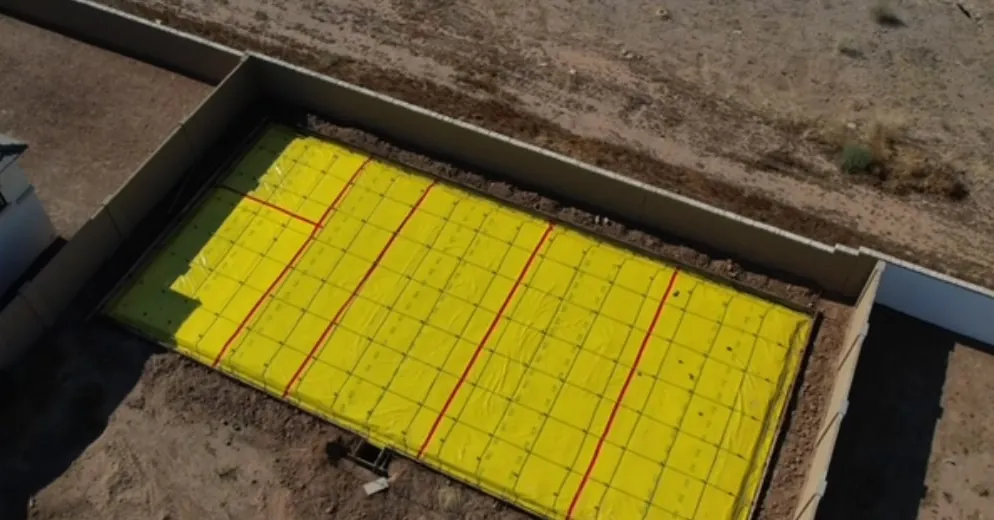
A small backyard tennis court is about practice and play, not regulation matches. Measure your yard against the sizes above first. For small yards, we build two Mini Court Game Centers: the Mini 1v1 on a 20x36 ft post-tension concrete slab and the Mini Doubles on a 26x45 ft slab. Each one is laid out around a painted mini pickleball court, and we confirm which size fits your yard during design.
- Mini 1v1: 20x36 ft slab with a 12x26 ft pickleball court
- Mini Doubles: 26x45 ft slab with a 20x35 ft pickleball court
- Both: one post-tension concrete slab, painted lines, room for more than one game
Mini 1v1: $16,999 complete package. Mini Doubles: $23,999 complete package. Each package is built around the painted mini pickleball court and includes a net and 4 paddles, a portable basketball hoop and a basketball, a shuffleboard set and a badminton set.
Compare every size side by side in our mini pickleball court dimensions guide, see the Mini Court Game Center, or add a backyard shuffleboard court lane.
Why a Post-Tension Concrete Slab
Every ball game needs a true bounce. A post-tension concrete slab gives a flat, hard base, and the acrylic sport surface on top adds color and traction. We pour a new slab for every game center rather than painting lines on an old patio, which tends to settle and crack.
How the Build Works
We look at your space and confirm which mini fits, lay out the slab and lines with you, pour the post-tension concrete slab, then paint once the concrete has cured. As a typical range, not a promise: we can usually be pouring concrete within a week, then the slab cures 21 to 28 days depending on weather before we paint. Live in an HOA community? We prepare the drawings and specs, and you submit them.
Have room for a full court? See backyard tennis court construction.
Mini Tennis Court FAQ
The red-ball mini court used for young players is 36 ft long and 18 ft wide, much smaller than a full doubles court at 78 ft by 36 ft.
A full court needs about 60 by 120 ft of fenced space. A mini red-ball court is 36 by 18 ft, so it needs far less room.
A flat, hard surface with a true bounce, such as concrete with an acrylic sport surface. Our Mini Court Game Centers are built on a post-tension concrete slab.
Check your HOA guidelines first. We prepare the drawings and specs for your game center, and you submit them to your HOA.
Build Your Game Center
Build your game center: call (480) 493-0031. Or call or text with photos and rough measurements of your yard. See both packages on the Mini Court Game Center page.
