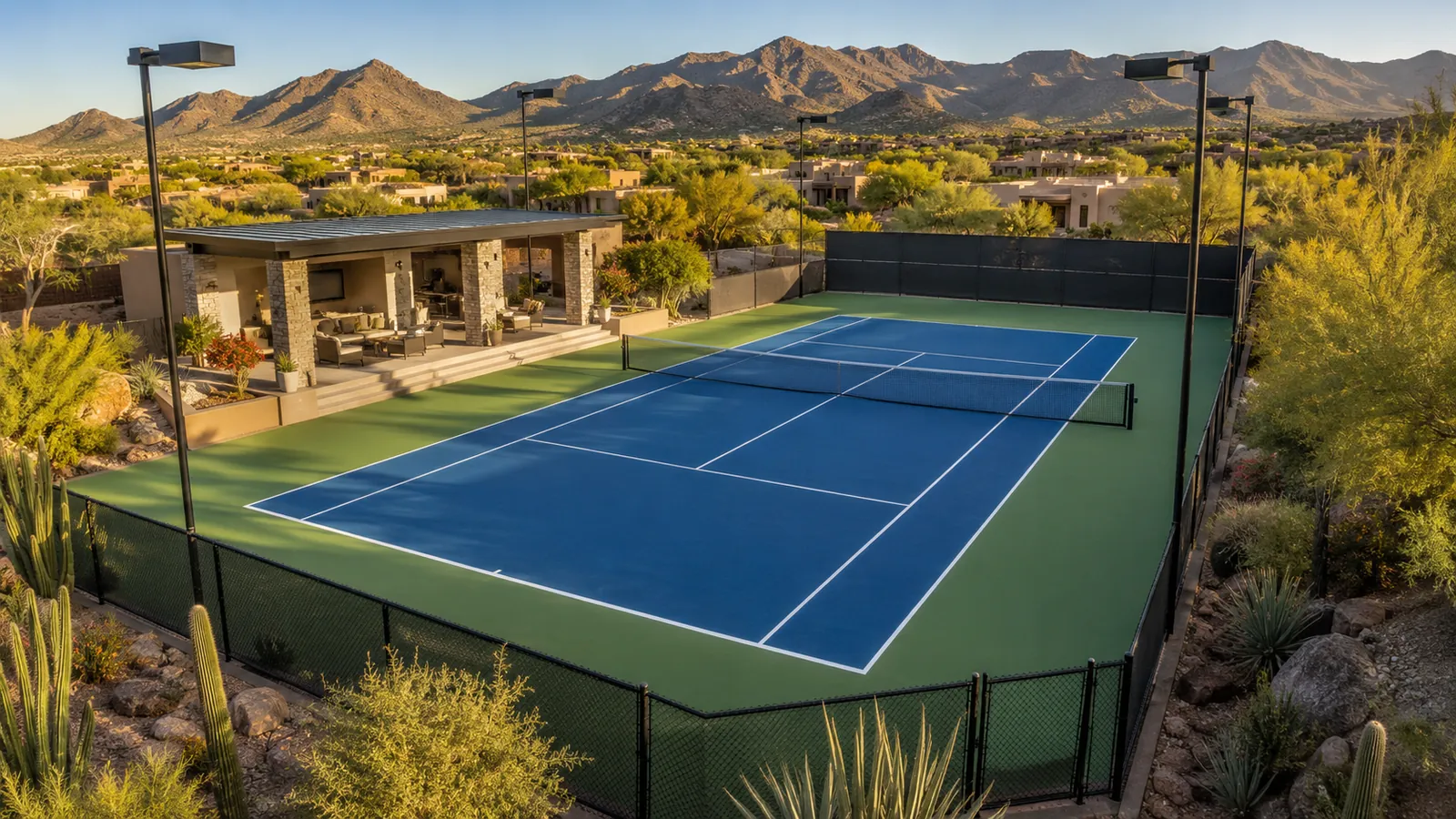
Cost to Build a Tennis Court in Arizona: Full Pricing Guide is an important topic for Arizona homeowners who want a better way to use their outdoor space. This guide is for homeowners who are researching court planning, comparing contractors, understanding cost, or deciding whether a backyard court is the right investment.
For homeowners across Phoenix, Scottsdale, Paradise Valley, Cave Creek, Carefree, Fountain Hills, Gilbert, Chandler, Mesa, Queen Creek, Glendale, Peoria, Surprise, North Scottsdale, Arcadia, Biltmore, Tempe, and surrounding Maricopa County communities, a properly planned court can support family play, private practice, fitness, guest entertainment, and long-term outdoor living. The key is choosing a plan that fits the site, the players, and the future use of the property.
Short Answer: What Affects the Cost to Build a Tennis Court?
The cost to build a tennis court depends on the total court footprint, property access, grading, drainage, base construction, acrylic surface system, fencing, lighting, net equipment, custom colors, and whether the court also includes pickleball lines.
A basic court on a flat, accessible lot will usually cost less than a luxury tennis court with grading, lighting, upgraded fencing, premium surfacing, and landscape integration.
Why Tennis Court Pricing Varies
Tennis court construction is not a fixed-price product. One property may already have a usable flat area, while another may need excavation, retaining work, drainage adjustments, and careful access planning. For the full build process from site evaluation to final finishing, see our guide to tennis court construction in Arizona.
This is why the price to build a tennis court should be based on the real property and scope rather than a generic online estimate.
Court Size and Total Footprint
The painted playing lines are only part of the project. A proper residential tennis court also needs space behind the baselines, along the sidelines, around the net posts, near fencing, and for access and maintenance.
More total square footage means more base construction, surfacing, line work, fencing, and labor.
Site Access, Grading, and Drainage
Difficult access can increase complexity. Narrow gates, walls, finished landscaping, pools, sloped driveways, and limited staging space can all affect how materials and equipment reach the court area.
Grading and drainage are also major variables. A court must be stable and should move water away from the surface without sending runoff toward patios, pools, homes, or neighboring properties.
Base and Surface System
The base is one of the most important parts of the cost. Concrete or asphalt must be prepared correctly so the surface plays properly and holds up over time.
Acrylic tennis court surfacing gives the finished court its color, texture, traction, and line visibility. Cushioned surface options, extra preparation, and custom colors can increase the budget. When the surface eventually wears down, see our guide to tennis court resurfacing contractors in Arizona for repair and refresh options.
Fencing, Lighting, and Net Equipment
Fencing is a significant cost factor because tennis courts usually require strong ball containment. Fence height, fence length, gates, material, and visual design all affect price.
Lighting adds cost through fixtures, poles, wiring, controls, and placement planning, but it can make the court much more useful during Arizona evenings.
Pickleball Lines and Multi-Sport Use
Adding pickleball lines can make a tennis court more useful for families, HOAs, and communities. It may add some cost through extra line work, color planning, and portable net equipment, but it can increase the value of the surface. For the full build process on the pickleball side, see our guide to pickleball court construction in Arizona.
The layout should remain clean and easy to understand so both sports work properly.
How to Manage the Budget
Homeowners can manage cost by choosing the best practical court location, planning before landscaping is finished, avoiding unnecessary design changes, and deciding which features matter most now versus later.
However, base construction, drainage, and surface preparation should not be reduced too much because they affect long-term performance.
Why Choose Dink Pro Courts?
Dink Pro Courts helps homeowners understand tennis court cost factors and create a plan that fits the property, budget, and intended use. A site-specific quote is the most accurate way to understand the final price. For projects that combine several sports on one surface, see our guide to game court contractors in Arizona.
The goal is not just to build a court, but to build the right court for the property.
Ready to plan one? See backyard tennis court construction in Arizona.
FAQs About Cost to Build a Tennis Court in Arizona
The biggest factors are court size, site prep, grading, drainage, base construction, surface system, fencing, and lighting.
Usually, yes, if the existing base is still suitable. A rebuild may be needed if the base has failed.
It can add some cost, but it can also make the court more useful for more players.
Yes. Lighting adds fixtures, poles, electrical planning, wiring, and controls.
Contact Dink Pro Courts for a site-specific evaluation and custom project quote.
